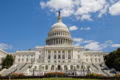
A decade after the bipartisan Lautenberg Amendments, Congress has built the record, heard the testimony, and proposed bills. Now it must act.
Ten years ago this June, President Obama signed the Frank R. Lautenberg Chemical Safety for the 21st Century Act into law. The House passed it 403–12. The Senate passed it by voice vote. Republicans and Democrats — environmental advocates, business leaders, labor, public health groups — agreed America deserved a Toxic Substances Control Act (TSCA) that protected human health and the environment while supporting innovation, investment, and American manufacturing. A decade later, the 119th Congress has a real opportunity to ensure TSCA is meeting those core goals — and the foundation to do it has never been stronger.
The Message Is Breaking Through
Something significant happened in two Congressional hearings this April. The lead Democratic Ranking Member of the House Environment Subcommittee, Rep. Paul Tonko (NY-20) identified the central problem with the new chemicals program by name: the backlog. In a separate hearing, the Democratic witness from Resources for the Future,Dr. Beia Spiller, identified the central problem with the existing chemicals program: conflicting regulations among federal agencies.
WATCH THEIR COMMENTS
When members and witnesses from both sides of the aisle are diagnosing the same problems in the same hearings, the message is breaking through. This is what bipartisan progress looks like.
Building a New Foundation
That moment did not happen overnight. In January 2025, the House Environment Subcommittee held the first TSCA hearing of the new Congress. The Senate Environment and Public Works (EPW) Committee followed. Over the course of 2025 and 2026, the House and Senate have held five TSCA-focused oversight and legislative hearings — building a robust record on exactly what needs to be fixed and how. Three bills are now before Congress. Together with that hearing record, they represent the most substantive legislative foundation for TSCA reform since the 2016 Lautenberg Amendments themselves.
The House Bill
On January 16, 2026, House Energy and Commerce CommitteeChairman Brett Guthrie (R-KY) and Subcommittee on EnvironmentChairman Gary Palmer (R-AL) released a discussion draft addressing EPA testing authorities, the Section 5 new chemicals review process, Section 6 management of existing chemicals already in commerce, and how TSCA fits with other federal laws and guidelines.
ACC welcomed the release as “a vital opportunity to get TSCA working as intended” and called for “the durable fixes to TSCA — for both new and existing chemicals — that make the U.S. the most competitive place in the world to manufacture chemicals.” At the January 22 hearing, ACCVice President of Regulatory and Scientific Affairs Dr. Kimberly Wise White, Ph.D.testified that Congress “rightly envisioned a risk-based, science-driven system under TSCA, not the speculative, opaque system we have now.”
The Senate EPW Bill
In late February, EPW Chairman Shelley Moore Capito (R-WV) released the Toxic Substances Control Act Fee Reauthorization and Improvement Act of 2026 — a targeted bill that reauthorizes EPA’s user-fee authority, clarifies the standard EPA applies in new chemical reviews, and requires program improvements and more efficient pathways for the review and approval of new chemistries.
ACC called the draft “a constructive and much-needed step toward restoring a TSCA program that works as Congress intended” and noted that “a predictable and efficient new chemicals process is essential to winning the race on innovation and maintaining U.S. leadership in chemistry and advanced manufacturing.” At the March 4 EPW hearing, Senator Pete Ricketts (R-NE) observed that more than 500 chemistries go into making a single computer chip, and that the current review process “has created more bottlenecks than actual progress to compete across the world.”
The Sound Science Act of 2026
Drawing on his deep engagement with TSCA through multiple EPW hearings, Senator Ricketts introduced the Sound Science Act of 2026 — legislation that promotes consistency and certainty for the foundational chemistries on which all economic sectors depend. The bill focuses on the scientific architecture under which EPA evaluates chemicals. Key provisions include:
Interagency consistency requirements prohibiting EPA from assuming noncompliance with applicable federal laws, including OSHA worker-safety standards.
A formal interagency review process giving the Departments of Defense, Energy, Agriculture, and OSHA meaningful input on the chemistries critical to those departments.
Complete in-person peer review of risk evaluations by EPA’s Science Advisory Committee on Chemicals (SACC).
ACC welcomed Senator Ricketts’ proposal. As ACCPresident and CEO Chris Jahn said: “Senator Ricketts is delivering leadership to American manufacturers and workers. The Sound Science Act gets the fundamentals right; regulatory decisions should rest on the best available science, and federal agencies should work from the same facts.”
Recognition Is Building
With each oversight hearing, each legislative hearing, and each new bill, the same conclusion emerges: TSCA, as amended in 2016, made necessary changes — but implementation hasn’t lived up to the promise. Each step is building the case among Members of Congress for reforms that are now undeniable: timelier and more predictable EPA reviews, science-driven and risk-based decision-making, real accountability, federal agencies working from a coherent set of facts, and the durable statutory foundation that long-cycle capital investment in U.S. manufacturing requires. There is no reason the 10th anniversary fixes cannot reflect the same bipartisan spirit that produced the 2016 law.
The stakes are clear. More than 444 new chemistries are stuck in EPA’s Section 5 new chemicals review queue — roughly 92 percent past their statutory 90-day deadline, more than 300 pending for over a year. The user-fee authority that funds about 25 percent of the program — paid by industry, not taxpayers — expires September 30. Every hearing, every question, and every bill has been building toward this deadline.
EPA Is on the Right Course
EPAAdministrator Lee Zeldin and Assistant Administrator Doug Troutman have taken meaningful steps to course-correct the program from the inside.
WATCH EPA'S GOALS FOR 2026
ACC has publicly credited that work. But administrative improvements are not always lasting and could be reversed by future administrations. The case for legislation is the case for permanence.
The Bottom Line
Improve, not reopen. The goal is not to rewrite TSCA from scratch — it is to fix the implementation issues that have become evident over the past decade and lock those fixes into statute.
ACC will continue to engage with both committees of jurisdiction, with Members across the aisle and on both sides of the Rotunda, to advance every legislative option in front of Congress.
Getting TSCA working effectively is critical to American competitiveness and manufacturing dominance. The 10th anniversary of the Lautenberg Amendments is the moment to deliver.